Wednesday, January 30, 2013

The Edge of Destruction

Hi All,


"The Edge of Destruction" Originally Transmitted February 8-15, 1964

Episode 1: The Edge of Destruction

Episode 2: The Brink of Disaster


Written by David Whitaker

Directed by Richard Martin (Episode 1) and Frank Cox (Episode 2)

Producer: Verity Lambert

An explosion within the TARDIS renders the travellers unconscious. When they regain consciousness, strange happenings begin to occur. The TARDIS doors begin erratically opening and then closing whenever Ian moves near them. Parts of the TARDIS console dish out electric shocks. The scanner shows pictures of previous journeys. The faces of all the clocks in the ship start to melt away. Susan seems to become almost possessed (her demeanour changes significantly to much darker and threatening) and threatens Ian and Barbara with a pair of scissors. Unable to locate any problem with the TARDIS, the Doctor openly accuses Ian and Barbara of being responsible.

Paranoia and mistrust is rife amongst a TARDIS crew on The Edge of Destruction. Source of Image: http://tardis.wikia.com/wiki/The_Edge_of_Destruction_%28TV_story%29
The travellers gradually begin to realise that what they have been experiencing is actually the TARDIS itself trying to warn them of something. When they left the planet Skaro, the Doctor had used the fast-return switch - a switch on the TARDIS console that returns the TARDIS to a previous location -  in an attempt to return Ian and Barbara to their own time. However, due to a faulty spring, the switch had gotten stuck and the TARDIS had been heading back to the very beginning of the universe and its own destruction - the forces involved in the creation of a solar system were starting to tear the ship apart. After the switch is fixed the TARDIS starts functioning normally again.

In Over the Edge, a documentary included as part of the DVD release, Richard Martin (the director of part 1) reveals that the two-part serial was a "budget saver" and a "time-maker". There was a delay in the script and costume departments for Marco Polo, a seven part serial originally scheduled to follow The Daleks, but production of the series had to keep moving. In addition, The Daleks had gone over budget, meaning there was no money available for any new sets to be built or to hire any additional actors for The Edge of Destruction. The script was written at the last minute by series script editor David Whitaker, and was set entirely aboard the TARDIS (meaning no new sets were required to be built) and featured only the four regular characters - the Doctor, Ian, Barbara and Susan. The fact that the script was a last-minute filler may go some way to explaining some shortcomings in the plot of this serial which leaves loose ends unaccounted for. For example, Susan's strange and sudden changes in behaviour (described above) are never explained satisfactorily.  

As noted by Verity Lambert (producer) in Over the Edge, The Edge of Destruction provided an ideal opportunity to focus on the main characters and to develop their relationships without any distractions from extraneous characters. In this regard, The Edge of Destruction is significant because it is a turning point. Prior to this point, the travellers are a disparate group. We see this overtly in The Daleks - when the Thals and the TARDIS crew split into two groups for an attack on the Dalek city, Ian and Barbara are in one group and the Doctor and Susan are with the other group. The friction between the Doctor and his human companions boils over in this two part serial, as the Doctor openly accuses them of being behind the strange goings on and threatens to put them off the ship. Barbara angrily refutes the Doctor's suspicions by reminding the Doctor that she and Ian risked their lives on Skaro to save the Doctor and Susan from the Daleks. She also cites Ian's bravery in the Cave of Skulls. It becomes apparent to the Doctor that Ian and Barbara are not to blame when the TARDIS's fault locator lights up, showing faults in every system. Another explosion rocks the ship. The Doctor realises the TARDIS's power source, located beneath the console, is trying to force its way out and they are only minutes from destruction (The Doctor declares "it would take the force of a total solar system to attract the power away from the TARDIS"). The four must then put their differences aside and work together. Once the problem with the fast return switch is discovered, thanks in a large part to some deductions by Barbara, the Doctor realises he has misjudged the pair and attempts to make amends. He apologises to Ian, who accepts straight away. Barbara needs more convincing but she is eventually won around. From this point on in the series we see a much closer knit TARDIS crew.

Other points of interest:

For the first time in the series we get hints that the TARDIS is something more than simply a machine.

At one point in episode one, Ian checks the Doctor's heart-rate and breathing and describes them as "normal". The idea that the Doctor's race, the Time Lords, have two hearts is a later development. In fact, at this point we haven't even heard the name Time Lord.

The Doctor never uses the fast-return switch again in the TV series (classic or revived). It has been used again in books and audio adventures.

In The Edge of Destruction, the fast-return switch is identified by the words "FAST RETURN" written above it in black felt on the TARDIS console:

The fast-return switch. Source of Image: http://tardis.wikia.com/wiki/Fast_Return_Switch
In Over the Edge, designer Raymond Cusick and producer Verity Lambert admit it was probably an oversight. It was probably meant as a guide for the actors, not intended to be seen on screen.

The Edge of Destruction is available on DVD as part of a box set, The Beginning, that also includes the previous two serials, An Unearthly Child and The Daleks. The set also includes a 30 minute condensed version of the lost serial Marco Polo that follows The Edge of Destruction, that uses bits of the surviving soundtrack and photo stills.


Thanks for reading,

Nick.

Cast announced for Mark Gatiss docudrama

Hi All,

A brief one tonight. Have just finished watching The Edge of Destruction, and will post on that interesting serial soon.

For now, some Hot-Off-The-Press news. As revealed in a previous post, the BBC has previously announced the lineup for the 50th anniversary year. This lineup included a 90 minute docudrama about the show's creation titled An Adventure in Time and Space, written by Doctor Who writer Mark Gatiss, due to be broadcast in the UK autumn (around the anniversary date in November presumably).

Filming is set to begin in February. Casting details have just been released.

In brief, David Bradley (Game of Thrones; Harry Potter) has been cast as William Hartnell. Bradley has also appeared in the most recent series of Doctor Who as Solomon in Dinosaurs on a Spaceship.


Other confirmed castings:

Brian Cox as BBC Head of Drama Sydney Newman:


Jessica Raine as Doctor Who's first producer Verity Lambert:


Sacha Dhawan as Waris Hussein, director of the first serial, An Unearthly Child:


All photos in this post have been taken from a Den of Geek! article about the casting announcements that you can read here.

Thanks for reading,

Nick.

Monday, January 28, 2013

Enter The Daleks

Hi All,


"The Daleks" (also known as "The Mutants" and "The Dead Planet") Transmitted December 21 1963- February 1, 1964

Episode 1: The Dead Planet

Episode 2: The Survivors

Episode 3: The Escape

Episode 4: The Ambush

Episode 5: The Expedition

Episode 6: The Ordeal

Episode 7: The Rescue


Written by Terry Nation

Directed by Christopher Barry and Richard Martin

Producer: Verity Lambert

In "The Daleks" we are introduced to the most iconic of the Doctor's enemies:

The Doctor encounters the Daleks for the first time. Source of image: http://tardis.wikia.com/wiki/The_Daleks_%28TV_story%29

It is probably not an exaggeration to say that the Daleks are a BIG part of the reason why Doctor Who has reached its Golden Anniversary.

As I mentioned in an earlier post,  in my opinion the previous serial "An Unearthly Child" holds up very well to viewing even after 50 years. A big part of that was due to the characterisations and performances of in particular the two lead actors, William Hartnell and William Russell. Throw in the fact that the Doctor and his granddaughter are mysterious alien beings who have been exiled from their (at this point unnamed) home planet and who are in possession of a machine that is "impossibly" bigger on the inside than on the outside and is capable of traveling ANYWHERE in time and space and I believe that there was enough of an indication after just one serial that Doctor Who had potential. But there was something missing! Some durable enemies perhaps?

What about the mutated descendants of an alien race, the result of a nuclear war that has almost destroyed their planet and that can only survive in life support machines shaped like giant pepper pots?

BRILLIANT! - We are on to a winner here!!!

And so, in defiance of the BBC's Head of Drama Sydney Newman's now legendary instructions "No Bug-Eyed Monsters!", the Daleks were born.

In "The Daleks", the TARDIS lands on an alien planet, Skaro, the home world of two races, the Daleks and the Thals, that has been devastated by a nuclear war between them. The radiation from the war has caused mutations to both races - as a consequence of these mutations the Daleks are now confined to armoured travel machines, which the Doctor later deduces are powered by static electricity, and limited to the boundaries of their metallic city. The mutation cycle has, in the words of the Doctor, "come full circle" for the humanoid Thals.

The Thals. Source of image: http://tardis.wikia.com/wiki/Thal
As a result of the devastation that generations of war resulted in, the Thals possess strong pacifist principles. They are a nomadic people desperately searching for new sources of food on a barren planet before their race succumbs to starvation. The TARDIS crew convince the Thals that their only chance of survival is to abandon their pacifist principles and fight - the Daleks have developed the means to artificially create enough food for both races to survive, but they are a malevolent race who desire the total extermination of the Thal people.  

As noted in my post on the preceding serial, "An Unearthly Child", there is a complexity to the Doctor's character in these early days of the series that is again evident in this serial. There are times when the Doctor is quite mischievous and selfish and almost seems to lack the sense of morality that we associate with the character later in time. For example, during their initial exploration of the petrified forest that the TARDIS has materialised in the travelers spot a metal city (the Dalek city) that the Doctor is keen to investigate but the others insist upon a return to the TARDIS.

The TARDIS crew spot the Dalek city. Source of image: http://tardis.wikia.com/wiki/The_Daleks_%28TV_story%29

On the way back to the TARDIS, Susan is separated from the others and frightened by what she insists was a human hand touching her on the shoulder. The others are skeptical. Once they are back in the TARDIS, strange knocking sounds and no trace of anybody outside on the TARDIS scanners provoke Ian, Barbara and Susan to insist that they leave the planet immediately. However, the Doctor, still keen to investigate the city, sabotages the TARDIS, preventing them from leaving. He claims (falsely) that mercury is needed for an essential component of the TARDIS - the fluid link, forcing the travelers to the city to look for some, eventually resulting in their capture by the Daleks.

At the city, Barbara is separated from the others and while looking for her the Doctor, Ian and Susan discover that the atmosphere of the planet is highly radioactive and that they've been walking around unprotected in it. Realising the gravity of the situation, the Doctor admits his sabotage and then suggests that they should leave immediately, abandoning Barbara! Such a suggestion would be completely out of the Doctor's character later in the series. Ian takes the fluid link hostage to ensure the Doctor helps him look for Barbara. When they are captured by the Daleks the fluid link is taken from Ian and it is the realisation of this when they escape from the city later in the serial, and the fact that they are stranded on Skaro without the fluid link, that leads them to try and convince the Thals of the need to fight.

Overall, "The Daleks" is another example of 60s Doctor Who that stands up pretty well almost 50 years later.

It is not difficult to see the relevance of "The Daleks" to the world in 1963. The Cuban Missile Crisis the previous year no doubt had the threat of nuclear conflict weighing heavily on people's minds. In "The Daleks" we see a world that has been devastated by such a conflict. In addition, the second world war was still well within living memory for most people. A memory of the war was ever-present in the films and comics of the era - and the Daleks were no exception.  In one scene, writer Terry Nation has the Daleks rank up alongside each other, raise their right arms in a stiff salute (echoing the Nazi salute) and announce: "Tomorrow we will be the masters of this planet."

Notice any similarities between these two images? Source of Images (top): http://www.kasterborous.com/2012/06/010-the-dalek-invasion-of-earth/, (bottom): http://www.answers.com/topic/adolf-hitler-large-image


The parallels between the Daleks and the Nazis grew bolder in later years. In "Genesis of the Daleks" (1975), traveling back in time, the Doctor (at this point played by Tom Baker) finds a pre-Dalek society where SS-style security officers wear jackboots, iron crosses and black shirts, and where High Command operates from a bunker. The newly created Daleks themselves are bred to be "racially pure".

'Dalekmania'

Despite these similarities (or perhaps because of them?) the Daleks turned out to be hugely popular with the viewing public. Not only did they ensure the success of the programme for years to come, they created a market for a vast array of merchandise.

Source of Image: http://www.richardwho.com/collectors/vuser/sub.asp?u=123&s=2

"Doctor Who's Astro-Ray Dalek Gun" Source of Image: http://tk.reddit.com/r/doctorwho/comments/16vdai/what_merchandise_would_you_like_to_see_for_the/
Dalek snowglobe. Source of Image: http://www.daleksoftheday.com/2011/08/1965-daleks-animated-snowstorm.html
Dalek playsuit. Source of Image: http://grahamward.blogspot.co.nz/2011/01/i-am-dalek.html
Cigarette Sweets (a different time indeed!). Source of Image: http://www.freewebs.com/recoveringthepast/apps/photos/photo?photoid=103853700

1965 saw the cinematic release of a Dalek movie in colour, "Dr. Who and the Daleks", starring Peter Cushing as a human scientist called Dr. Who. The screenplay was based on the Daleks first TV serial, described above.

Source: http://en.wikipedia.org/wiki/Dr._Who_and_the_Daleks

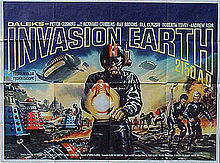
The success of the film meant it was followed a year later by a second film, "Daleks - Invasion Earth: 2150 A.D.", based on the Daleks' second appearance in the TV series, "The Dalek Invasion of Earth" (1964).

Source of Image: http://en.wikipedia.org/wiki/Daleks_%E2%80%93_Invasion_Earth:_2150_A.D.

And finally, it feels appropriate to sign off with a Youtube clip of one of my latest Doctor Who related acquisitions - a Desktop-patrol Dalek - a Christmas present from my sister Natasha:


50 years later and the Dalek merchandising machine is still going strong! :-)

Bye for now,

Nick.


Friday, January 25, 2013

Panel Discussions from the BFI's An Unearthly Child Event

Hi All,

Just a brief follow up to an earlier post on this blog (BFI's Doctor Who at 50, posted on 21/01).

As mentioned in that post, as part of the 50th anniversary celebrations, the British Film Institute (BFI) has launched Doctor Who at 50. Every month they’ll be holding a screening of a classic story - each month a different Doctor - and reuniting many luminaries from the world of Doctor Who.

The first screening, held on the 12th of January, was the very first serial, from 1963, "An Unearthly Child" (for my thoughts on this serial see Back to the beginning: An Unearthly Child). Guests at the screening included William Russell (Ian Chesterton), Carole Anne Ford (Susan), Jeremy Young (Kal), Waris Hussein (Director of An Unearthly Child), and Donald Tosh (Doctor Who script editor in 1965).

I have just found these videos of the delightful panel discussion that took place following the screenings and thought that they really were worth a share:


And here is a link to Patrick Mulkern's article about the event on the Radio Times' website again

Enjoy,

Nick.


50th Anniversary Year Lineup Revealed!!!

Hi All,

OK, I'm a couple of days late with this, but in case you are not already aware BBC Worldwide has launched a new Doctor Who website. You can visit it at:

http://www.doctorwho.tv/

The website contains profiles of Doctor Who characters - the Doctor's 11 incarnations, companions and monsters/villains, as well as a number of clips and pics from the show (at the moment there is a focus on the Hartnell and Smith years but more characters and clips will be added over time). There's also some on-line games to play and an on-line shop.

And details about the 50th anniversary lineup have also been released by the BBC.

The 2013 programming will include:

8 episodes making up the second part of series 7 (transmission beginning in the UK and on BBC America on March 30th - NZ dates have not presently been confirmed by Prime TV)

A 60 minute 50th anniversary special broadcast in the UK autumn (presumably sometime close to November 23)

An Adventure in Time and Space, a one-off 90 minute docudrama about the show's creation written by Doctor Who writer Mark Gatiss, also due to be broadcast in the UK autumn.  

Doctor Who Revisited: 11 x 25 minute features each month on BBC America to coincide with screenings of classic stories throughout the year - one story from each Doctor, beginning with The Aztecs on January 27.

In Australasia, UKTV has begun screening classic stories, each month a different Doctor.

With regards to the 60 minute 50th anniversary special there is talk that the script will feature ALL ELEVEN ACTORS to have played the role since 1963. Apparently Moffat is close to completing a script that will feature all incarnations of the Time Lord - with studio trickery used to resurrect the first three Doctors – William Hartnell, Patrick Troughton and Jon Pertwee – in brief flashback scenes. All that said, I recently noticed that Colin Baker (the sixth Doctor) mentioned on Twitter that he had not been approached to take part in any 50th anniversary stories, but whether they've been told to say that to keep the lid on the surprise, I guess we'll just have to wait and see ...

Thanks for Reading,
Nick.


Thursday, January 24, 2013

Upcoming Dr Who DVD releases (Classic Series)

Hi All,

2013 is set to see the release on DVD of the final two complete serials from the classic series of Doctor Who (1963-1989), in time for the 50th anniversary. The two serials are The Mind of Evil (1971) and Terror of the Zygons (1975).

So far, January 2013 has already seen the DVD release of the unfinished serial, Shada, starring Tom Baker as the Doctor and Lalla Ward as Romana and written by then Doctor Who script editor Douglas Adams, author of The Hitchhiker's Guide to the Galaxy. Filming of this serial was not completed as a result of industrial action at the BBC. Tom Baker provides linking narration to complete the story, as in a previous VHS release. This has been released as part of a boxed set, The Legacy Collection, that also includes a 1994 documentary, More than 30 Years in the Tardis. Also included in the set is the 2003 animated webcast version of Shada by Big Finish Productions featuring Paul McGann as the Doctor, with Lalla Ward reprising her role as Romana. This version can only be viewed on a web browser which does seem a bit pointless considering that it is actually available FREE from the BBC Website.


The next scheduled DVD release for 2013 is The Reign of Terror (1964), the final serial of the very first season of Doctor Who, which sees the Doctor (William Hartnell) and his companions Ian, Barbara and Susan become involved in intrigues during the French Revolution.
 
The scheduled date for release in the UK is the 28th of January (Feb 6 for NZ and Australia). Of the six part serial, only episodes 1- 3 and 6 are complete in the BBC archives (episodes 4 and 5 are lost as a result of the wiping of a number of tapes for re-use in line with studio policy at the time). However, this DVD release will include animated reconstructions of the missing episodes, as was the case for the DVD release of The Invasion (1968) in 2006.

Here's a taster of what the animation will look like:

http://www.youtube.com/watch?feature=player_embedded&v=hXvk8HbYQL0


 Other DVD releases scheduled for 2013:

A new special edition of the Tom Baker classic The Ark in Space (1975). The scheduled release date for the UK is the 18th of February (Feb 27 for Australasia).

A new special edition of The Aztecs (1964). The scheduled release date for the UK is the 11th of March (March 20 for Australasia). Although this adventure, starring William Hartnell as the Doctor, has been previously released on DVD, this edition has been eagerly anticipated by fans since the announcement that the extras will include Air Lock, the 3rd episode of another Hartnell serial, Galaxy Four (1965), rediscovered in 2011.

Here is a clip from Air Lock:


The Terror of the Zygons (1975), starring Tom Baker as the Doctor. The scheduled release date for the UK is the 25th of June (Release date for Australasia TBA).

A newly colour-restored version of The Mind of Evil (1971), release date TBA. Like a number of stories starring Jon Pertwee as the Doctor, the colour master videotapes for this serial were wiped by the BBC in the 1970s. This left only black and white film recording copies of the episodes, made for overseas sale, in the archives.

The public premiere of the newly colour-restored version of The Mind of Evil will take place on March 10th, part of the British Film Institute's Doctor Who at 50 series.

Thanks for Reading,
Nick.


Wednesday, January 23, 2013

Doctor Who becomes legal tender

Hi All,

Hot off the press: Doctor Who's 50th anniversary is being marked with a series of collectible coins to be issued by New Zealand Mint in association with BBC Worldwide Australia:

http://www.stuff.co.nz/entertainment/tv/8219281/Doctor-Who-becomes-legal-tender

All eleven actors to have played the role of the Doctor will be commemorated in the set. An additional 1oz silver commemorative coin featuring an engraved picture of the TARDIS, is currently available for pre-order from the New Zealand Mint website:

The obverse side of the coin features the Ian Rank-Broadley effigy of Her Majesty Queen Elizabeth II. The coin is issued by New Zealand Mint as legal tender (denomination $2) under the authority of Niue Island, a Pacific Island nation in free association with New Zealand.
The coin is packaged in a model replica of the TARDIS. The doors of the TARDIS slide open to display the coin and certificate of authenticity inside. But be warned - it is not cheap - NZ$155 (US$130.73) inc. shipping.